
Call Debit Spreads
The Options Strategy That Changed How I Invest With A Small Account

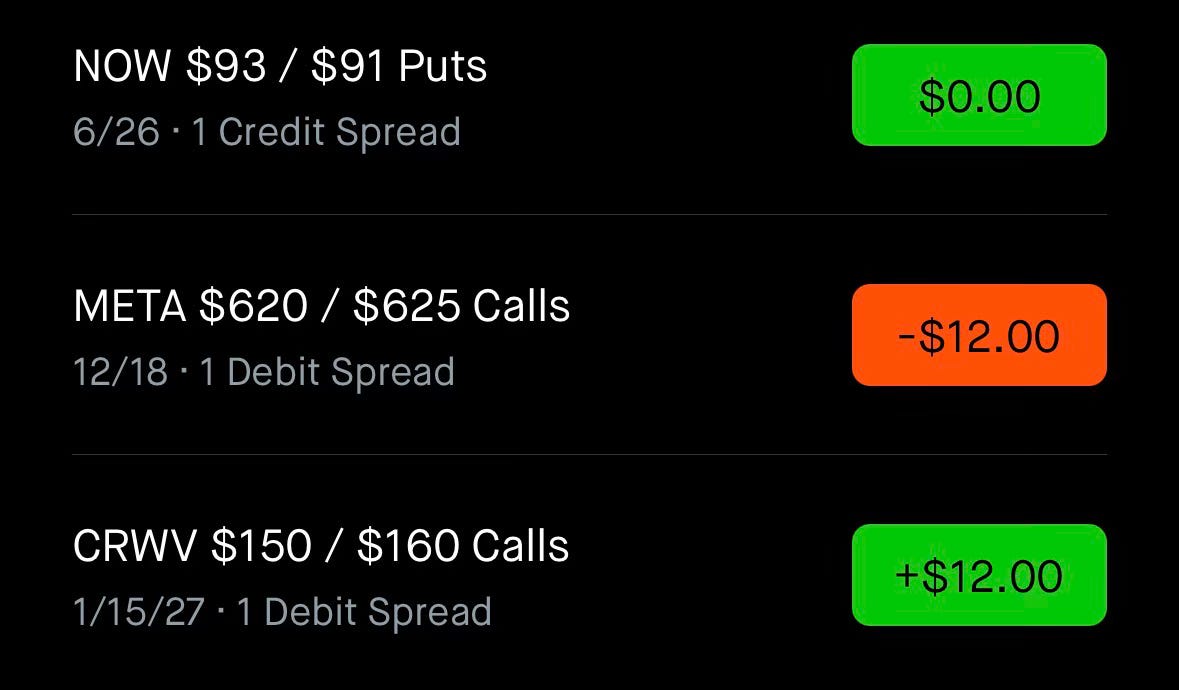
Options strategies have a reputation for being complicated, and honestly, that reputation scares most retail investors away before they even give them a fair shot. Spreads in particular tend to be the strategy people avoid the most, too many moving parts, too confusing, too risky. But here is the truth: call debit spreads have become one of the most important tools in my portfolio. They let me get meaningful upside exposure to stocks I am deeply convicted on without needing the capital to buy shares outright or pay expensive premiums for single-leg calls. If you have a small account and a long-term bullish outlook on specific names, this strategy deserves your full attention. Let me break it all down.
The Technicals: How A Call Debit Spread Actually Works
A call debit spread, also called a bull call spread, involves two legs executed at the same time on the same stock with the same expiration date. You buy a call option at a lower strike price and simultaneously sell a call option at a higher strike price. The premium you collect from selling the higher strike partially offsets the cost of buying the lower strike, which is exactly what makes this strategy so capital efficient.
The Width
The width of your spread is simply the difference between your two strike prices. A $10-wide spread means your long strike and your short strike are $10 apart. Width matters because it directly determines your maximum profit potential. A wider spread gives you more room to capture upside but also costs more in premium. A narrower spread is cheaper but caps your gains sooner.
The Premium
The net premium you pay is your total cost and your maximum loss on the trade. If you buy a $230 call for $8.00 and sell a $240 call for $3.00, your net debit is $5.00 per share, or $500 per contract since each contract represents 100 shares. That $500 is the most you can ever lose on that position, no matter what the stock does. That defined risk is one of the biggest advantages of this structure over buying naked calls.
Calculating Max Profit
Max profit is calculated by taking the width of the spread and subtracting the net premium paid. Using the example above, a $10-wide spread purchased for $5.00 nets you a max profit of $5.00 per share, or $500 per contract. To capture that full profit, the stock needs to be at or above your short strike at expiration. If the stock closes anywhere below your long strike at expiration, you lose the full premium paid. If it closes between your two strikes, your profit is calculated proportionally.
Breakeven At Expiration
Your breakeven point is your long strike price plus the net premium paid. In the example above, if you bought the $230 call and paid a $5.00 net debit, your breakeven at expiration is $235. The stock needs to be above $235 at expiration for you to make any money on the trade. This is why strike selection and time horizon matter so much when building these positions.
How Theta Works
Theta is the rate at which an option loses value due to time passing, and it is something every spread trader needs to understand. The good news with call debit spreads is that theta is not your biggest enemy, especially early in the life of the contract. Both legs of your spread are experiencing time decay simultaneously. Your long call is losing value to theta while your short call is also decaying, and those effects partially offset each other. However, as you get into the final weeks before expiration, theta accelerates sharply. The last 30 days of an options contract is where time decay becomes most aggressive. This is why I prefer spreads with longer expirations on my highest conviction trades, giving the thesis time to play out before theta becomes a meaningful drag on the position.
Stacking Vertical Spreads: How To Build A Position Over Time
One of the most underrated aspects of call debit spreads is the ability to stack them. Stacking means opening multiple spread positions on the same stock at different times, different strikes, or different expirations as your conviction grows or as the stock moves in your favor.
Here is a real scenario to walk through. Let’s say you are bullish on a stock trading at $120 and you open your first spread: a $125/$135 call debit spread expiring in six months for a net debit of $4.00. You are risking $400 per contract with a max profit of $600 if the stock hits $135.
A month later, the stock has pulled back to $115. Your thesis has not changed. In fact, you feel even more convicted because the fundamentals are strong and the price is lower. You open a second spread: a $120/$130 call debit spread on the same stock for $3.50. Now you have two positions working. Your average cost basis across both spreads is lower, your overall upside exposure is larger, and you still have clearly defined risk on every single contract.
Now let’s say the stock rallies to $130. Your second spread (the $120/$130) is approaching max profit territory. You can either close it and lock in the gain, or let it ride. Meanwhile your first spread (the $125/$135) still has more room to run. You now have optionality on two positions that you built systematically over time without ever putting up more capital than you were comfortable losing.
This is the power of stacking. It is not about putting everything in at once. It is about building a position in layers as the opportunity presents itself, always with defined risk, always with a clear understanding of what you stand to gain and what you stand to lose. For a small account, this approach lets you scale into conviction without overcommitting capital to any single entry point.